Laser Tattoo Removal in Chicago: Prices and How to Choose
Chicago is a big market with a short list of dedicated removal studios, which changes how you should shop for one. Here is what a session costs and how to judge a clinic when there are not many nearby.
silvano para

Laser tattoo removal in Chicago runs about $150 to $400 per session, and a full course of 6 to 12 sessions lands between $900 and $4,400 depending on size and ink colors. The catch in this city is not price, it is supply: dedicated removal studios are thin on the ground compared with New York or Los Angeles, and a lot of the capacity sits in the suburbs rather than inside the city limits.
This guide covers what you should expect to pay, which Chicago clinics are currently listed in our directory, and how to judge a clinic properly when there are only a few within driving distance.
What laser tattoo removal costs in Chicago
Chicago sits in the middle of the national range. A single session across the United States runs $75 to $500, and most Chicago quotes for a normal tattoo come in between $150 and $400. Downtown and North Side clinics price at the higher end; med spas in the western and northern suburbs tend to sit $25 to $75 lower per visit for the same work.
| Tattoo size | City clinic, per session | Suburban med spa, per session | Typical full course |
|---|---|---|---|
| Small (under 3 in) | $150 to $225 | $125 to $200 | $900 to $2,000 |
| Medium (3 to 6 in) | $200 to $300 | $175 to $275 | $1,400 to $3,000 |
| Large (6 to 12 in) | $275 to $400 | $250 to $350 | $2,200 to $4,400 |
Half sleeves, full sleeves and back pieces are quoted individually and sit above these ranges, often priced per treatment block rather than per tattoo. Three variables move the number more than anything else: physical size, how many ink colors are in the piece (black clears fastest, green and sky blue slowest), and whether the laser is owned by a physician practice or a standalone studio. If you want an estimate for your specific tattoo before you start calling, our tattoo removal cost calculator works out likely cost and session count from size, colors, placement and age.
One Chicago-specific note on packages. Because there are fewer providers competing for the same customer, prepaid course discounts here tend to be smaller than in denser markets, more like 10 to 15 percent than 25 percent. That is not a reason to skip them, but it does mean locking in a 10 session package on your first visit buys you less than you might expect. Health insurance will not help either way: US insurers treat tattoo removal as cosmetic and do not cover it. If cost is the blocker, it is worth reading about free and low cost tattoo removal programs, which usually exist through hospital systems and reentry or gang tattoo initiatives rather than through commercial clinics.
Tattoo removal clinics listed in Chicago
Being honest about it: our Chicago list is short. Four clinics are currently in the directory, and for a metro area of nine million people that is nowhere near complete. We are publishing it anyway because a short verified list is more useful than a padded one, and because it grows as clinics claim their listings.
- Hindsight Tattoo Removal, a removal-focused studio rather than a general aesthetics practice.
- Chicago Aesthetics Med Spa, offering removal alongside other laser services.
- Skin Laser & Med Spa, also in the city.
- Enfuse Medical Spa in Elmhurst, roughly 20 miles west of the Loop and a realistic option if you are anywhere along the I-290 or the Metra UP-W line.
We do not rank these, take commission from them, or verify licenses and certifications. Treat the list as a starting point for phone calls, not a recommendation. You can see the current set any time on the Chicago tattoo removal directory page, which updates as new clinics are added.
If you run a removal clinic or a med spa in Chicago, Evanston, Oak Park, Naperville, Schaumburg or anywhere else in the metro, add your listing. Coverage gaps like this one are exactly what we are trying to close, and a listing with real hours, a real phone number and an accurate description of your equipment is worth more to a person mid-search than another paid ad.
How to evaluate a clinic when you only have a handful nearby
In a market with fifty removal studios you can afford to walk away from anyone who gives a vague answer. With four or five realistic options you need a sharper filter, because the goal shifts from finding the best to confirming that a given clinic is competent for your particular tattoo.
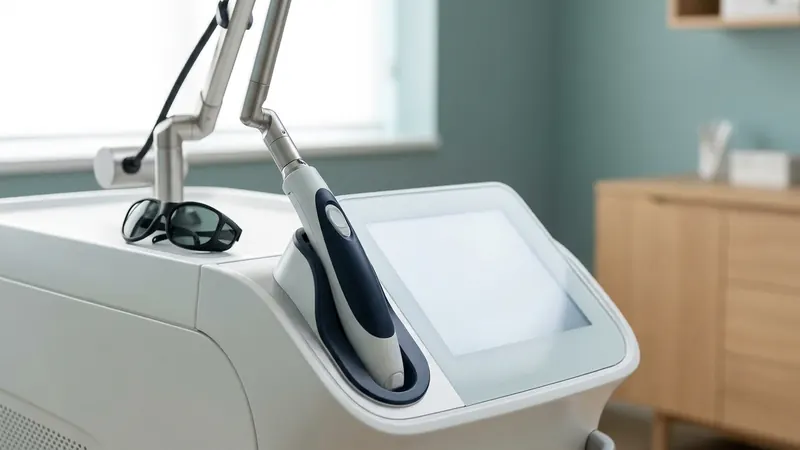
Four questions do most of the work, and all four can be answered over the phone before you spend an afternoon on a consultation.
- Which wavelengths does your laser have? Black and dark blue respond to 1064 nm, red to 532 nm, and green and sky blue need 694 nm or 755 nm. A clinic without the right head will stall halfway through a colorful tattoo no matter how new the machine is. This single question eliminates the wrong clinics faster than anything else.
- Is it Q-switched or picosecond? Q-switched systems fire in nanoseconds and have been the standard for decades. Picosecond platforms such as PicoSure, PicoWay and Enlighten fire a thousand times faster and often clear a tattoo in fewer visits at a higher price per visit, so the total is frequently similar. Our guide to picosecond tattoo removal covers where the difference is real and where it is marketing.
- Who actually operates the laser, and who supervises? Illinois does not regulate cosmetic laser operators as tightly as New York does, so the answer varies a lot between practices. Ask for the person's training and how many tattoos they treat in a month.
- Can I see before and after photos of tattoos like mine? Same colors, similar skin tone, similar age of ink. Clean black outlines on pale skin prove very little.
If you have Fitzpatrick type IV to VI skin, add a fifth question: will you do a test patch first, and will you treat me at 1064 nm with lower fluence? The right answer is yes to both, with sessions spaced 8 to 12 weeks rather than 6 to 8. Our page on tattoo removal on dark skin explains what a careful protocol looks like so you can tell whether the answer you get is a real one.
When driving to the suburbs is worth it
Chicagoans are conditioned to treat a 45 minute drive as an ordeal, but the arithmetic of tattoo removal changes that calculation. You are not booking one appointment. You are booking six to twelve appointments spaced 6 to 8 weeks apart, spread across a year or more.
That means a suburban clinic with the right wavelength for your green ink beats a closer clinic that will get you 70 percent of the way and then plateau. It also means a $50 per session saving is worth roughly $300 to $600 across a full course, which covers a lot of gas and parking. What does not justify the drive is a marginally cheaper session on older equipment, because if it adds three extra visits you have paid more in both money and time.
A practical middle path in this metro: book consultations at one city clinic and one suburban clinic, ask all four questions above at both, and compare the quotes side by side. Consultations are almost always free, and quotes for an identical tattoo routinely differ by a factor of two.
Why winter is the right time to start in Chicago
Sun exposure between sessions forces a practitioner to lower the energy, which adds visits, and freshly treated skin is more prone to pigment changes if it gets tanned or burned. Starting a course in November or December means the first several treatments happen while the treated area is under sleeves anyway, and you arrive at July with most of the clearing already done.
The rest of the routine is the same regardless of season: keep the area clean and covered for the first few days, no picking at blisters, no swimming pools or hot tubs until the skin has closed, and daily sunscreen on the site for as long as you are in treatment. Our tattoo removal aftercare guide covers the full timeline, including what a normal blister looks like and when redness stops being normal.
Frequently asked questions
How much does it cost to remove a small tattoo in Chicago?
Roughly $150 to $225 per session in the city and $125 to $200 in the suburbs, over 6 to 10 sessions. That puts a small black tattoo somewhere between $900 and $2,000 for the complete course.
Why are there so few tattoo removal clinics listed in Chicago?
Because coverage is built clinic by clinic and Chicago is still early in the process. Four listings does not mean four clinics exist in the metro area. If you know a good one, or you operate one, adding it to the directory takes a few minutes.
How long will the whole process take?
Sessions are spaced 6 to 8 weeks apart, so eight sessions is roughly a year. Multi-color pieces, heavy blackwork and layered cover-ups can run to 12 to 15 sessions and take closer to two years.
Does Illinois require a doctor to operate the laser?
Illinois rules are looser than in states like New York, where a licensed medical professional or direct physician supervision is required. That makes the question worth asking directly rather than assuming, and it is one reason a physician-led practice is the safer choice if you have had a bad reaction before or you are treating a cosmetic or white pigment.
Can I just get the tattoo lightened for a cover-up instead?
Yes, and say so at the consultation. Fading for a cover-up takes 2 to 4 sessions rather than a full course, usually $300 to $900 in this market, and your new artist should tell you how much lightening the design actually needs before you book.
Ready to start calling? The current list of laser tattoo removal clinics in Chicago has addresses, phone numbers and hours for every clinic above, and it grows as more of the city and its suburbs get added.
Comments(0)