Laser Tattoo Removal in Atlanta: Prices and Darker Skin
Atlanta treats a larger share of Fitzpatrick IV to VI skin than most US markets, and that single fact should shape how you choose a clinic here more than price does.
silvano para

If you are getting a tattoo removed in Atlanta, the most important sentence in your consultation is not about price. It is whether the clinic will treat a small test area first and wait a month before touching the rest. Metro Atlanta has a high proportion of patients with Fitzpatrick IV to VI skin, and on that skin the wrong wavelength or too much energy causes pigment damage that outlasts the tattoo. Sessions here run about $125 to $350, and the clinics worth your money are the ones that will happily go slower than you want them to.
What removal costs across metro Atlanta
Atlanta sits in the middle of the national range, cheaper than the Northeast and the West Coast, more expensive than smaller Southern markets. Intown clinics in Midtown and Buckhead price higher than the ones outside the Perimeter. Note that a safe protocol on darker skin usually means more sessions at lower energy, so compare the likely course total rather than the headline per session number.
| Tattoo size | Atlanta price per session | Sessions on Fitzpatrick I to III | Sessions on Fitzpatrick IV to VI |
|---|---|---|---|
| Very small (under 2 sq in) | $125 to $175 | 5 to 7 | 7 to 10 |
| Small (wrist, ankle, 2 to 6 sq in) | $150 to $225 | 6 to 9 | 8 to 12 |
| Medium (forearm, shoulder) | $200 to $275 | 7 to 10 | 9 to 13 |
| Large (half sleeve, back panel) | $250 to $350 | 8 to 12 | 10 to 15 |
| Full sleeve or full back | $350 and up, treated in sections | 10 to 15 | 12 to 18 |
Estimate your own range with the tattoo removal cost calculator, then treat the extra sessions in the right hand column as the price of doing this safely rather than as a clinic padding the bill. Several Atlanta clinics sell unlimited or guaranteed-to-completion packages; those can work well precisely because a conservative protocol takes more visits, but read what happens if you move away or stop mid-course.
Clinics by area
Listings run from Midtown and Buckhead out through Sandy Springs and Decatur to Peachtree City. Confirm the current address on each listing page before you drive, and remember that this directory does not verify licenses or credentials.
Midtown and Buckhead
LaserAway Atlanta Midtown and LaserAway Atlanta – Buckhead are the intown chain locations, convenient if you work in the Midtown corridor. Atlanta Dermatology and Laser Surgery and Dermatology Associates of Atlanta – Laser Institute of Georgia are dermatology led practices, and they are the more appropriate starting point if you have keloid history, prior pigment problems or a tattoo that has already been treated somewhere else. Plastic Surgery Centre of Atlanta / Alchemy Aesthetics offers removal within a surgical practice.
Sandy Springs, Decatur and the Perimeter
Removery Tattoo Removal & Fading – Sandy Springs and Removery Tattoo Removal & Fading – Decatur are removal-only locations, which usually means the operators do nothing else all day. For patients coming in from Marietta, Dunwoody or Roswell, the Sandy Springs side of the Perimeter is generally the shorter drive than crossing into town.
South and southwest metro
Removery Tattoo Removal & Fading – Camp Creek serves the southwest side near the airport corridor, and Advanced Dermatology at SkinCare 5th Ave covers the southern suburbs from Peachtree City. Over a 10 to 15 visit course spread across two years, proximity matters more than most people expect at the consultation.
The protocol that should not be negotiable
Melanin absorbs laser light. On Fitzpatrick IV to VI skin the epidermis sitting above your tattoo competes with the ink for the same energy, and if it absorbs too much you get thermal injury to the pigment producing cells rather than to the ink. That is the whole problem in one sentence, and everything below follows from it.
- 1064 nm as the primary wavelength. Nd:YAG at 1064 nm is the least absorbed by melanin and is the standard choice for black and dark blue ink on darker skin. 532 nm, used for red, and 694 nm or 755 nm, used for greens and sky blues, carry higher risk and need extra care.
- Lower fluence, more sessions. A conservative operator deliberately under-treats to protect the epidermis and accepts a longer course. If someone promises fast clearance at high energy on Fitzpatrick V skin, walk out.
- Intervals of 8 to 12 weeks. Not the 6 to 8 weeks quoted for lighter skin. The gap gives inflammation time to settle so you are not stacking injury on injury.
- A test patch, waited out. A coin sized area treated at the planned settings, then four to six weeks of observation before anyone treats the full tattoo. This is the step clinics skip when they are busy, and it is the one that catches a problem while it is still the size of a dime.
Our full guide to tattoo removal on dark skin goes deeper into settings, cooling and what an honest consultation sounds like. Bring the questions with you.
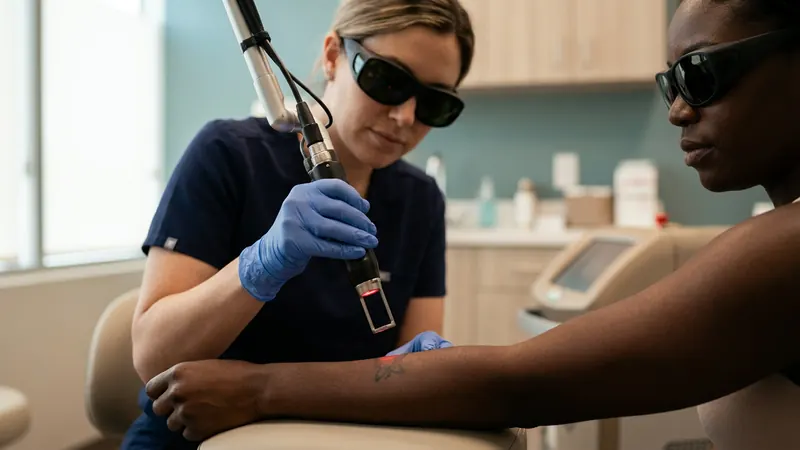
What goes wrong, and what it looks like
Two pigment complications account for most of the bad outcomes, and they behave differently.
Post-inflammatory hyperpigmentation is a brown or darker patch appearing at the treated site weeks after a session. It is common on darker skin, it is usually temporary, and it typically fades over 3 to 12 months with strict sun protection. It is a reason to lengthen your intervals, not necessarily to stop.
Hypopigmentation is the opposite: a pale patch where melanin production has been damaged. It can be permanent, and it is the outcome the conservative protocol exists to prevent. If you see a lightening halo forming around treated areas, raise it before your next appointment rather than after.
Keloid and hypertrophic scarring is the third risk, and it matters here because keloid tendency is more common on darker skin. If you scar thickly from piercings, acne or minor cuts, say so at the consultation. That history should change the plan before the first pass, and it is a reason to choose a dermatology practice over a walk-in aesthetics location.
Fading for a cover-up, a lower risk goal
Full clearance is not the only option, and on darker skin it is often not the smartest one. If you already know you want new work in the same place, you only need the old tattoo light enough for an artist to design over it, which takes 2 to 4 sessions and roughly $300 to $900 total instead of a two year course. Fewer sessions at conservative energy also means far less cumulative pigment risk. Talk to your tattoo artist first, get their opinion on how much lightening they need, and read our guide to tattoo fading for a cover-up before you book. Several Atlanta clinics work directly with local artists on exactly this.
Aftercare in Georgia humidity
Aftercare on darker skin is not a different routine, it is the same routine followed more strictly, because the penalty for inflammation is higher. Keep the site clean and covered, do not pick blisters, avoid pools and hot tubs until the skin has closed, and stay out of direct sun for the entire course. Atlanta summers add friction and sweat to the equation, so loose clothing over the site beats a tight sleeve, and sunscreen goes on only after the skin has fully healed. The complete routine is on our tattoo removal aftercare page.
Frequently asked questions
Is laser tattoo removal safe on Black skin?
Yes, when it is done with 1064 nm, conservative fluence, long intervals and a test patch first. The risk is not the treatment itself, it is aggressive settings on the wrong wavelength. Ask the clinic directly how many patients with your skin type they treat and what wavelength they plan to use on each color in your tattoo.
Why will my course take longer than my friend's?
Because the safe approach uses less energy per session. You are trading visits for a lower risk of permanent pigment change. Expect 8 to 12 weeks between sessions instead of 6 to 8, which stretches a 10 session plan across roughly two years.
What should a test patch cost?
Many Atlanta clinics fold it into the consultation or charge a small fee, and some apply it toward the first full session. If a clinic refuses to do one on Fitzpatrick IV to VI skin, that answer alone tells you enough.
Can colored ink be removed on darker skin?
It is harder. Red responds to 532 nm and greens and sky blues to 694 nm or 755 nm, and those wavelengths are absorbed more strongly by melanin. Some clinics will treat black areas fully and leave color partially faded rather than push a risky wavelength. That is a legitimate, honest plan, and you should know it is the plan before you start.
Does insurance cover any of this in Georgia?
No. US health insurance classifies tattoo removal as cosmetic. Payment plans and prepaid packages are common in metro Atlanta; compare the per session rate inside a package against the single visit price before you sign.
What about white or pastel ink in the design?
Flag it. White and pastel inks usually contain titanium dioxide, which can oxidize under the laser and turn gray or black on the first pass. It is generally treatable with further sessions, but it is another argument for testing a small area before anyone treats a whole piece.
Compare consultations, addresses and hours across the metro in our Atlanta tattoo removal directory, and make the test patch question the first one you ask.
Comments(0)